




“Are lab grown diamonds actually real diamonds?”
This is usually the first question customers ask, and one of the most important.
The answer is yes. Lab grown diamonds are real diamonds.
They have the same chemical, physical, and optical properties as natural diamonds. Both are made of pure carbon crystallized in a diamond structure.
The biggest difference between lab grown and natural diamonds is how they are formed:
- Natural diamonds develop deep within the Earth over billions of years.
- Lab grown diamonds are created in controlled laboratory environments using advanced technology that replicates the same growing conditions.
Many shoppers initially assume lab diamonds are more similar to cubic zirconia or moissanite, but those are diamond simulants, not diamonds. Lab grown diamonds are genuine diamonds and are graded using the same standards as natural diamonds, including cut, color, clarity, and carat weight.
One thing our jewelry specialists often notice is that customers tend to shift their perspective once they see lab grown diamonds in person. The conversation usually moves from “Are they real?” to “Which option feels right for me personally?”

“Will a lab grown diamond look different from a natural diamond?”
Many customers expect lab grown diamonds to look noticeably different in person.
In reality, even trained gemologists cannot distinguish a lab grown diamond from a natural diamond with the naked eye. Gemologists use specialized screening equipment to determine whether a diamond is lab grown or natural.
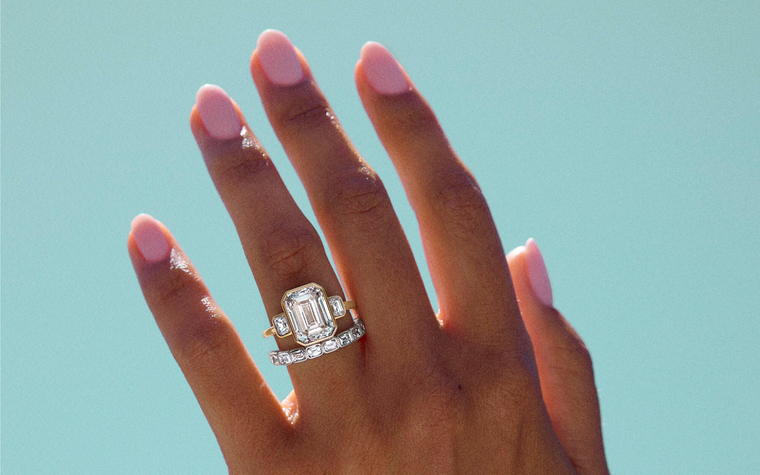
Lab grown diamonds display the same brilliance, fire, and scintillation as natural diamonds because they share the same optical performance.
Customers are often surprised when viewing lab grown and natural diamonds side by side because there is no visible difference in appearance.
Some shoppers even arrive assuming lab diamonds may look cloudy, overly bright, or artificial over time. But because lab grown diamonds possess the same visual characteristics as natural diamonds, they maintain the same beauty and sparkle over time.

“Are lab grown diamonds durable enough for everyday wear?”
This is one of the most common concerns we hear from engagement ring shoppers.
Customers often wonder whether a diamond created in a laboratory might be softer or less durable than one formed naturally within the Earth.
But lab grown diamonds have the same physical durability as natural diamonds. Both rank 10 on the Mohs hardness scale, making them the hardest known gemstone material.
That means lab grown diamonds are highly resistant to scratching and well suited for everyday wear, including engagement rings intended to be worn for decades.
For many customers, this becomes a turning point in the decision-making process. Once they understand that lab grown diamonds offer the same durability as natural diamonds, the conversation often becomes less about performance and more about personal preference, symbolism, or budget priorities.
Some customers also ask whether lab grown diamonds can become family heirlooms. Because they possess the same durability and longevity as natural diamonds, lab grown diamonds can absolutely be worn, passed down, and treasured for generations.

“Are lab grown diamonds flawless?”
Another common misconception is that lab grown diamonds are all perfectly flawless because they are created in laboratory settings.
But just like natural diamonds, lab grown diamonds can contain inclusions and clarity characteristics. No two diamonds are exactly alike.
This is why clarity grading still matters when selecting a lab grown diamond. Depending on the stone, inclusions may or may not be visible to the naked eye.
Customers are often surprised to learn that lab grown diamonds still have unique characteristics and variations, rather than being “mass-produced perfect stones.”
That individuality is part of what makes every diamond, whether lab grown or natural, distinct.

“What’s the actual difference between lab grown and natural diamonds?”
After learning how similar the two are, many customers eventually ask the bigger question: if lab grown and natural diamonds are physically identical, what actually makes them different?
The answer comes down to origin and personal meaning.
For some customers, the geological rarity and history of natural diamonds hold deep emotional significance. Others are drawn to lab grown diamonds for their accessibility, innovation, or ability to prioritize size and quality within a budget.
What our jewelry specialists often observe is that there is rarely a universally “correct” choice. Instead, customers tend to choose the diamond that best aligns with their values, priorities, and personal story.

The Bottom Line
Many of the misconceptions surrounding lab grown diamonds come from outdated assumptions about what they are and how they compare to natural diamonds.
What customers often discover during the shopping process is that lab grown diamonds are not imitation stones or lower-quality alternatives. They are real diamonds with the same beauty, durability, and optical performance as natural diamonds.
The primary difference is simply origin: one forms naturally within the Earth, while the other is created using technology that replicates nature’s diamond-growing process.
For many shoppers, the biggest surprise is not how different lab grown diamonds are from natural diamonds, but how similar they are.
As more customers explore both options, conversations around lab grown diamonds are becoming less about whether they are “real” and more about which type of diamond feels most meaningful for their lifestyle, priorities, and personal preferences.
