



 Start with Our Diamond Quiz


4 Cs of Diamonds Charts
Created by the Gemological Institute of America (GIA) in the 1940s, the 4 Cs — cut, color, clarity, and carat — serve as the universal standard for assessing diamond quality. Each C represents a distinct quality attribute, measured on its own scale:
- Cut: Graded from Excellent to Poor on the GIA scale and Ideal to Poor on the International Gemological Institute (IGI) scale
- Color: Graded from D (colorless) to Z (light yellow or brown)
- Clarity: Graded from Flawless (FL) to Included (I3)
- Carat: Measured in metric carats, where one carat equals 200 milligrams


Diamond Cut
Cut determines how effectively a diamond's facets interact with light, creating the gem’s signature brilliance and sparkle. Unlike other diamond characteristics that form during the growth process, cut quality results from the diamond cutter's skill and precision. A masterfully cut diamond reflects optimal brilliance, disperses vivid fire-like colors, and creates dynamic sparkle patterns when moved (this is called scintillation).
The GIA grades diamond cut from Excellent to Poor based on proportions that maximize light performance. An Excellent cut diamond returns nearly all light that enters the gem, resulting in exceptional sparkle and visual impact. In contrast, a Poor cut allows light to escape through the pavilion (bottom), resulting in a dull appearance regardless of the diamond's other qualities.

D Color
Absolutely colorless or icy white. The highest color grade—extremely rare and most expensive.
Diamond Color
Diamond color refers to the absence of color, with completely colorless diamonds being the most valuable and rare. The GIA color grading scale ranges from D (colorless) to Z, with each letter grade representing a subtle increase in color saturation. Diamonds that fall outside this range — such as vivid pinks or blues — are classified as "fancy colored" and are evaluated differently.
Color becomes increasingly noticeable as carat weight increases, making color grade particularly important when selecting larger diamonds. Strategic color selection should balance budget considerations with:
- Your chosen mounting style (yellow gold can make near-colorless diamonds appear whiter)
- Diamond size (larger diamonds reveal color more readily)
- Diamond shape (step-cut emerald and asscher shapes tend to display more color than brilliant cuts, which mask color with their superior light-dispersing properties)

Diamond Clarity
Clarity measures how free a diamond is from inclusions (internal characteristics) and blemishes (surface flaws). The GIA clarity scale ranges from Flawless to Included. Most diamonds fall somewhere in between, with inclusions that are microscopic and don't impact their beauty.
The impact of inclusions varies dramatically depending on their size, number, and position. The location of an inclusion matters as much as its size — an inclusion directly under the table (top facet) affects appearance more than one hidden near the girdle (edge). This makes each diamond's clarity assessment nuanced and highlights the value of viewing diamonds individually rather than relying solely on certification.

Actual Diamond Size on Size 6 Hand
Diamond Carat
Carat is a measurement unit that describes a diamond's weight, with one carat equaling 200 milligrams (roughly the weight of a paperclip). It's important to understand that two diamonds of identical carat weight can appear noticeably different in size depending on their shape and cut. A well-cut diamond maximizes surface area and light performance, often appearing larger than a poorly cut gem of equal weight.
For maximum value, consider diamonds just below popular weight thresholds (0.9 instead of 1.0 carat, 1.9 instead of 2.0 carats), where prices often drop significantly without a perceptible difference in visual size.
Diamond Shape
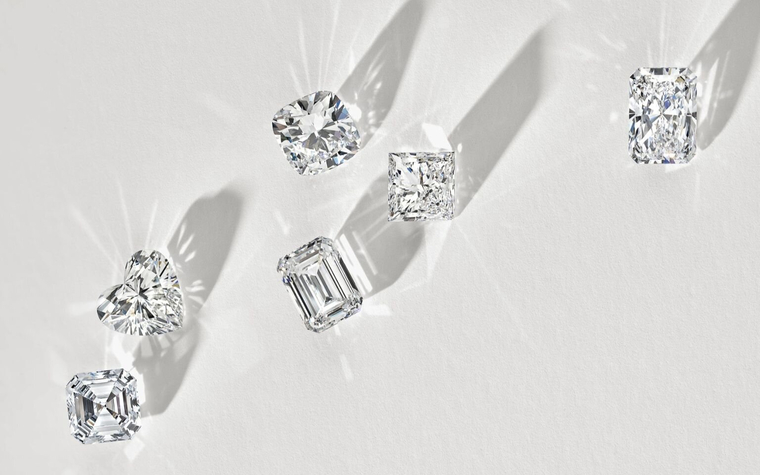
Shape refers to a diamond's outline when viewed from above and should not be confused with cut, which describes the gem's facet arrangement. The most popular shape remains the round brilliant, and any non-round shape (such as emerald, marquise, oval, or princess) is considered a "fancy shape."
Each shape provides distinct benefits: emerald cuts produce an elegant "hall-of-mirrors" effect, oval and marquise shapes can make fingers appear slimmer, and princess cuts offer brilliant sparkle in a contemporary square silhouette.
Beyond appearance, shape selection involves practical considerations:
- Price (fancy shapes typically cost less than round brilliants of comparable quality)
- Durability (pointed corners in marquise, pear, and princess cuts benefit from protective settings to prevent chipping)
- Visual impact (elongated shapes like oval and marquise often appear larger per carat than round brilliants due to their greater surface area)


Diamond Size
Diamond size — distinct from carat weight though often mistakenly used interchangeably — refers specifically to a gem's physical dimensions and visual presence, most commonly measured in millimeters across the widest points.
When evaluating size, consider actual millimeter measurements rather than relying solely on carat weight. A standard 1-carat round brilliant typically measures about 6.5mm in diameter, while a well-cut oval or marquise of the same weight may appear larger due to their elongated shape and greater spread.
For engagement rings, the setting style further influences perceived size — halos (small diamonds surrounding the center gem) can make a diamond appear larger, while cathedral settings elevate the gem for greater prominence.

Types of Diamonds
Natural Diamonds
Natural diamonds form deep within the Earth under extreme conditions of heat and pressure over billions of years. They are comprised of nearly 99.95% carbon — making diamonds the only gemstone constructed of a single element. They are the hardest naturally occurring materials found on Earth and gem-quality diamonds are one of the most sought-after. Because of their limited quantity, natural diamonds have been cherished for their enduring value and passed from generation to generation.
Lab Diamonds
Lab diamonds are optically, chemically, and physically the same as natural diamonds. Their difference lies only in their origins — natural diamonds form within the Earth, and lab diamonds are grown by professionals with specialized equipment. Another difference is cost; as lab grown diamonds are less rare than natural diamonds, they often come at a much more accessible price.

4 Cs of Diamonds Tips: Finding Your Perfect Combination
Finding your dream diamond requires balancing the 4 Cs with your personal priorities. Here are a few tips from our Brilliant Earth gemologists to help guide your decision:
1. Master the 4 Cs. To discover the ideal diamond for you, develop an understanding of how each factor affects a diamond's appearance and value. Then, determine which characteristics matter most to you personally. If exceptional brilliance is your priority, emphasize cut quality above all else. If impressive size makes the greatest impact for you, you might strategically compromise on color, cut, or clarity to get a greater carat weight. Remember that there's no universally "correct" combination — your aesthetic preferences should guide the way.
2. Target value "sweet spots". Certain grade combinations offer superior value by delivering an excellent appearance without commanding premium prices:
- Color: H-J diamonds present exceptional value, appearing near colorless to the naked eye
- Clarity: Depending on carat weight and shape, VS2-SI1 grades can appear "eye-clean" without the substantial premiums of higher clarity grades
3. Select your signature shape. Round diamonds offer unmatched brilliance and traditional appeal, but typically command higher prices than fancy shapes, which can provide better value and a distinctive appearance. Choose the shape that resonates with your personal style, whether you're drawn to timeless rounds or the unique character of fancy shapes like oval, cushion, or emerald.
4. Ensure proper certification. Your diamond should come with a comprehensive grading report from a respected independent laboratory such as GIA, IGI, HRD, or GCAL. These certificates verify your diamond's authenticity and provide objective documentation of its quality characteristics. Please note that all Brilliant Earth center stones are certified.

Diamond Quiz
Do you need help finding your dream diamond? Our quiz is here to help you discover the perfect one.
4 Cs of Diamonds FAQ
Which of the 4 Cs is most important in diamonds?
Cut is generally considered the most important of the 4 Cs because it has the greatest impact on a diamond's brilliance and overall appearance. However, the "most important" C is ultimately a matter of personal preference.
What is the best combination of the 4 Cs of diamonds?
There's no single "best" combination, as it depends on individual preferences and budget. However, for maximum visual appeal, many experts recommend prioritizing excellent cut, color in the G-J range, clarity in the VS1-SI1 range, and the highest carat weight your budget allows. This combination typically yields a diamond that appears colorless to the naked eye, has no visible inclusions, displays excellent brilliance, and maximizes size.
What is a diamond?
A diamond is crystallized carbon formed under extreme pressure and temperature in a lab or deep within the Earth over billions of years. It ranks as the hardest known substance and valued for its exceptional hardness (10 on the Mohs scale), brilliance, and fire.
What is a certified diamond?
Certified diamonds are diamonds certified by independent institutions such as the Gemological Institute of America (GIA), the International Gemological Institute (IGI), HRD Antwerp, and the Gem Certification & Assurance Lab (GCAL). All Brilliant Earth center diamonds are certified.
To grade a diamond, professionals use equipment to assess cut, color, clarity, and carat. They may also plot a diagram of its clarity characteristics and a graphic representation of its proportions.
How hard are diamonds?
Diamonds are the hardest known substance found on Earth. They are so hard that they rank at the highest hardness level (a 10) on the Mohs scale. Therefore, diamonds are ideal for everyday wear, making them perfect as center gems in jewelry as well as engagement rings.
How much does a diamond cost?
Diamond price varies greatly depending on rarity and quality. Diamonds with higher grades in cut, color, or clarity, or diamonds with a larger carat weight, are rarer and therefore more expensive than those with lower grades or carat weights. Lab grown diamonds are less rare than natural diamonds and are therefore less expensive.
What are the diamond grades?
Diamonds are graded on a scale developed by the Gemological Institute of America (GIA) that analyzes cut, color, clarity, and carat. These 4 Cs are universally acknowledged as the accepted standard in describing and determining the quality of any diamond:
- Cut: Excellent, Very Good, Good, Fair, Poor (or Ideal, Very Good, Fair, Poor if you have an IGI certificate)
- Color: D-Z, with D being colorless and Z showing noticeable yellow or brown tint
- Clarity: FL (Flawless), IF (Internally Flawless), VVS1-VVS2 (Very, Very Slightly Included), VS1-VS2 (Very Slightly Included), SI1-SI2 (Slightly Included), I1-I3 (Included)
- Carat: Measured by weight, where 1 carat = 0.2 grams
How rare are diamonds?
Gem quality diamonds remain quite rare, as most rough diamonds found in mines are low-quality and only used for industrial purposes.
How do diamond testers work?
Diamond testers are handheld tools that test thermal or electrical conductivity to identify whether a stone is a diamond. To learn more, reference our Do Lab Grown Diamonds Pass a Diamond Tester guide.
What month’s birthstone is a diamond?
Diamonds are the traditional birthstone for April. Beyond being a birthstone, diamonds are also the traditional gift for 60th and 75th wedding anniversaries, representing the enduring strength of long-lasting relationships.
What does diamond accent mean?
A diamond accent is a small diamond along the band or setting of engagement rings, wedding rings, or fine jewelry. Generally, accents are any other diamonds besides the center gemstone of a given piece.
What makes a diamond sparkle?
A diamond's sparkle results from three optical effects:
- Brilliance: The white light reflected from the interior and exterior of the diamond
- Fire: The rainbow flashes produced when light is dispersed into its spectral colors
- Scintillation: The pattern of light and dark areas and the flashes of light when the diamond, light source, or observer moves
These effects depend primarily on the diamond's cut quality. A well-cut diamond has precise angles and proportions that maximize light return through the crown (top) of the diamond. When light enters the diamond, it bounces off the internal facets and returns through the top, creating the characteristic sparkle. A poor cut allows light to escape through the bottom or sides, reducing sparkle significantly.
What do diamonds represent?
Diamonds represent the birth month of April and are said to symbolize strength, love, and health in ancient lore. These representations have made diamonds meaningful gemstones for significant life moments and celebrations.
What is a melee diamond?
A melee diamond is a tiny diamond set into the setting of a piece of fine jewelry.
What is an enhanced diamond?
Enhanced diamonds are those that have undergone specific treatment to improve either their clarity or their color. Brilliant Earth does not carry enhanced diamonds.
